Ministry of Justice UK
Adjudications Discovery
Digital Prison Services
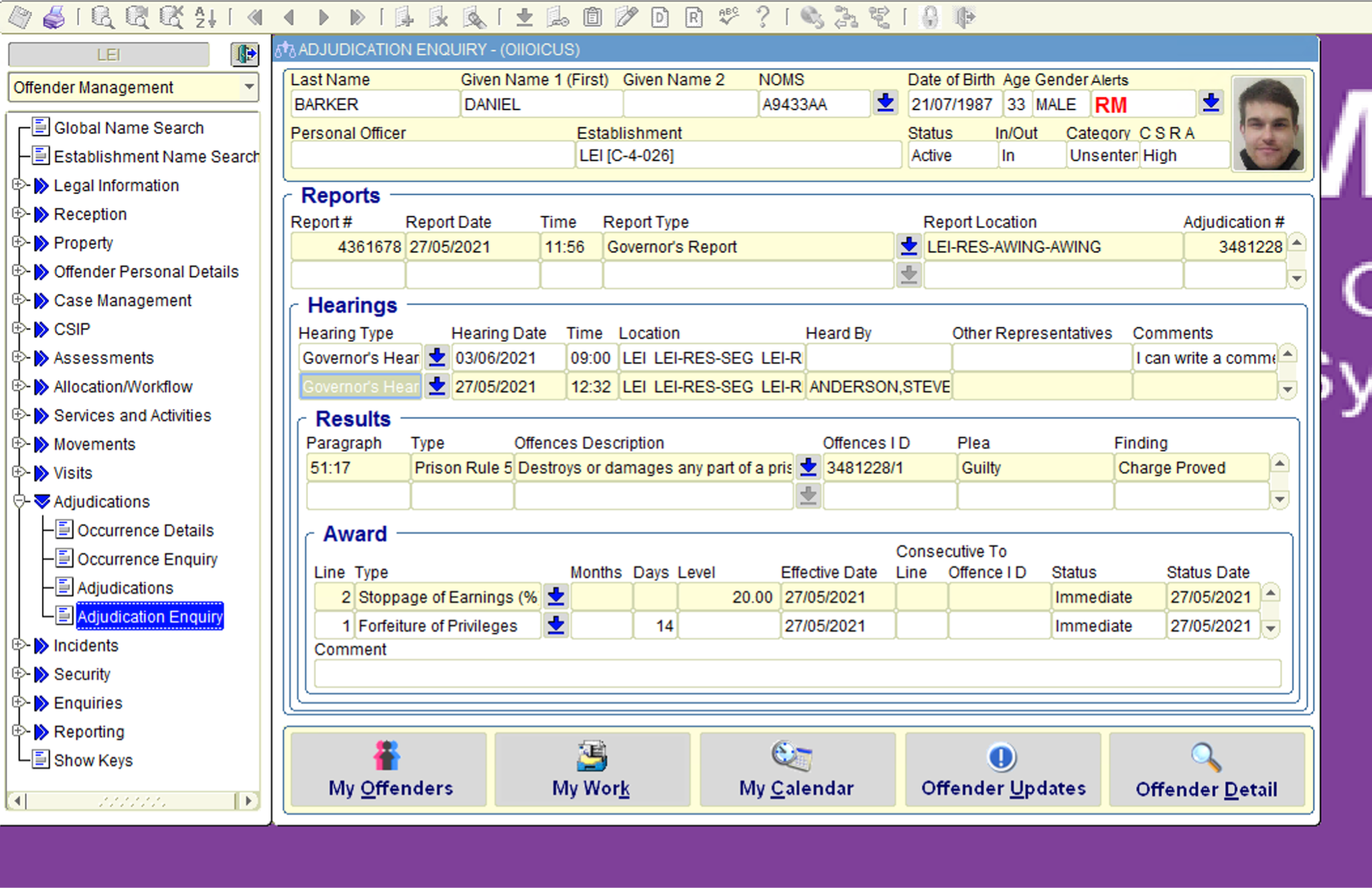
275,000 prison adjudications a year. Almost all on paper.
A paper-based process costing £13M a year and not achieving its purpose. Discovery research to understand why and whether a digital service could do better.
At a glance
| Organisation | Ministry of Justice UK |
|---|---|
| Service | Digital Prison Services — Adjudications |
| Role | Senior UX Researcher |
| Type | Discovery · Mixed methods · Service design |
| Participants | 40+ governors, officers, policy leads, adjudicators |
| Timeline | 9 months |
| Outcome | Passed GDS Discovery Assessment · £100K secured for Alpha |
The context
An adjudication is the formal process for handling prisoner misconduct: from the incident report to the hearing to the outcome. 275,000 happen in the UK every year. All managed on paper, duplicated by hand, frequently delayed, often dismissed on technicalities.
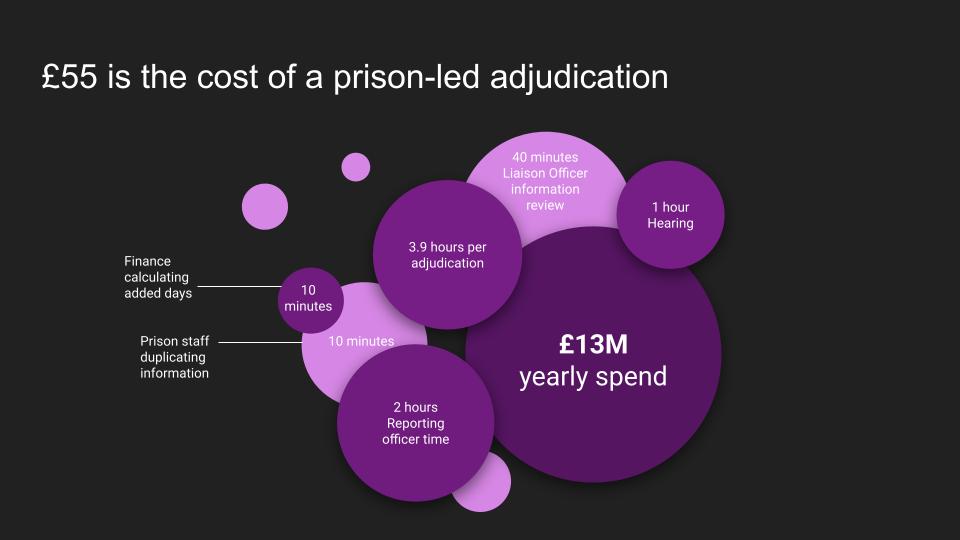
The process cost £55 per case and £13M a year in staff time. It was not changing prisoner behaviour. Something was broken.
The right question
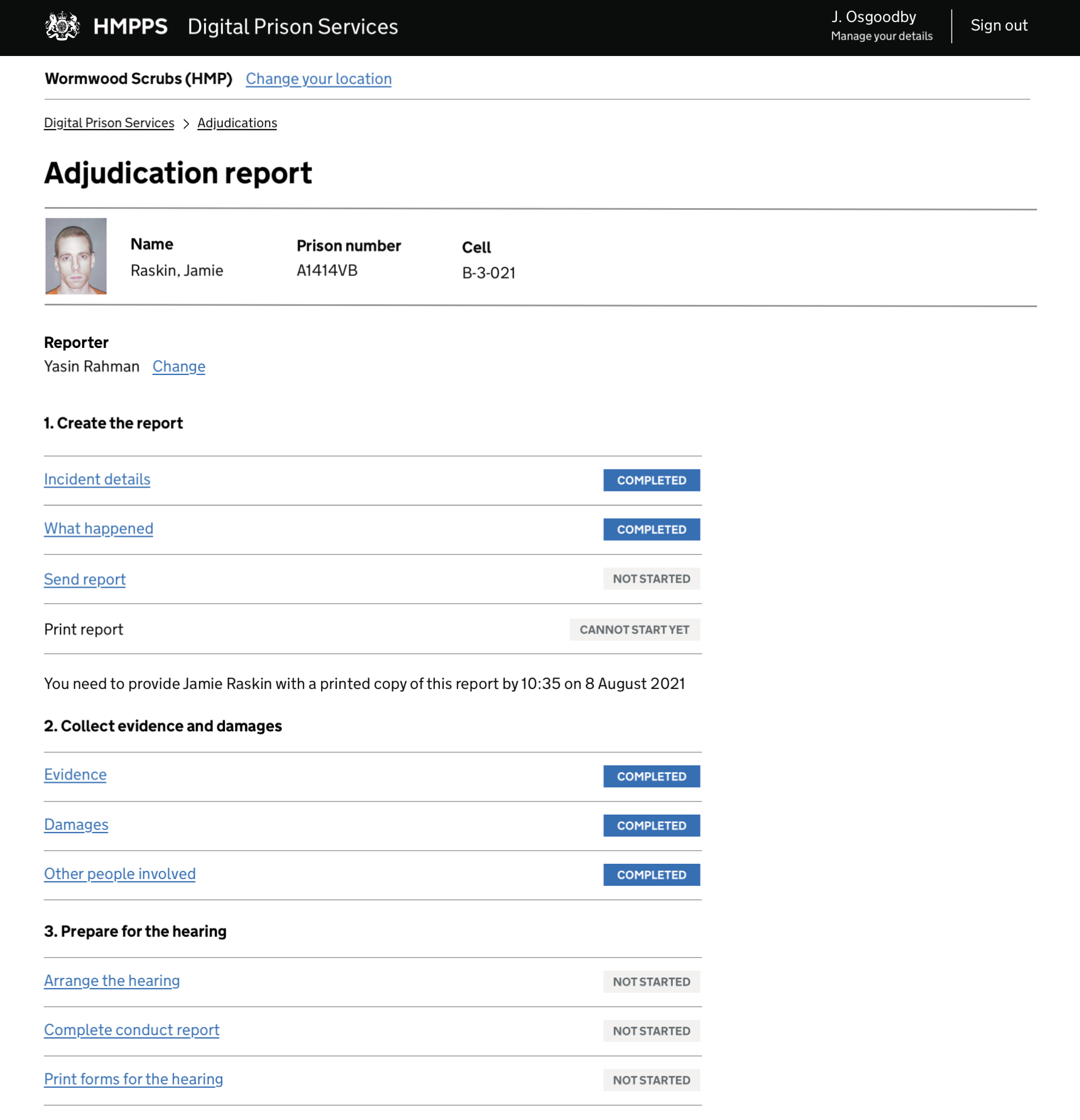
The initial assumption was straightforward: a digital adjudications process would create a more effective service. Replace paper with software, reduce errors, speed things up.
What the research revealed was a different problem altogether. Staff and governors were not just struggling with paperwork. They were losing confidence in the process itself. Adjudications were being dismissed on technicalities. Prisoners did not understand what was happening or why. Officers were uncertain about their own role.
The question shifted. Not: how do we digitise this process? But: can we create a fairer, more trusted adjudications service by making the process self-explanatory, reducing the conditions that cause it to fail, and ensuring outcomes are understood by everyone involved?
That reframe changed what we measured, who we talked to, and what we recommended.
How I approached it
The domain was completely new to me. Prison governance, Prison Rule 51, the roles of governors, reporting officers, adjudication liaison officers, independent adjudicators: a world with its own language, constraints, and politics.
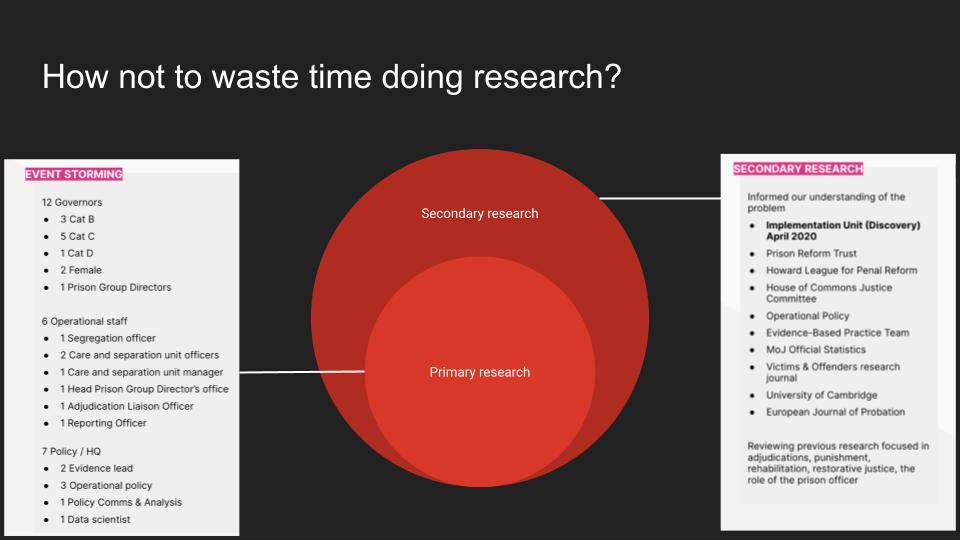
Ran secondary research first: academic literature, Prison Reform Trust reports, House of Commons Justice Committee documents, MoJ official statistics. Then I knew enough to ask the right questions.
Secondary research before interviews. Every time.
What I did
- Ran secondary research across policy documents, academic papers, and government reports to understand the system before talking to anyone inside it.
- Learned the domain constraints through event storming sessions with 40+ participants across the prison hierarchy: governors, operational staff, policy leads and adjudication liaison officers. Mapping the whole system, not just one user's view.
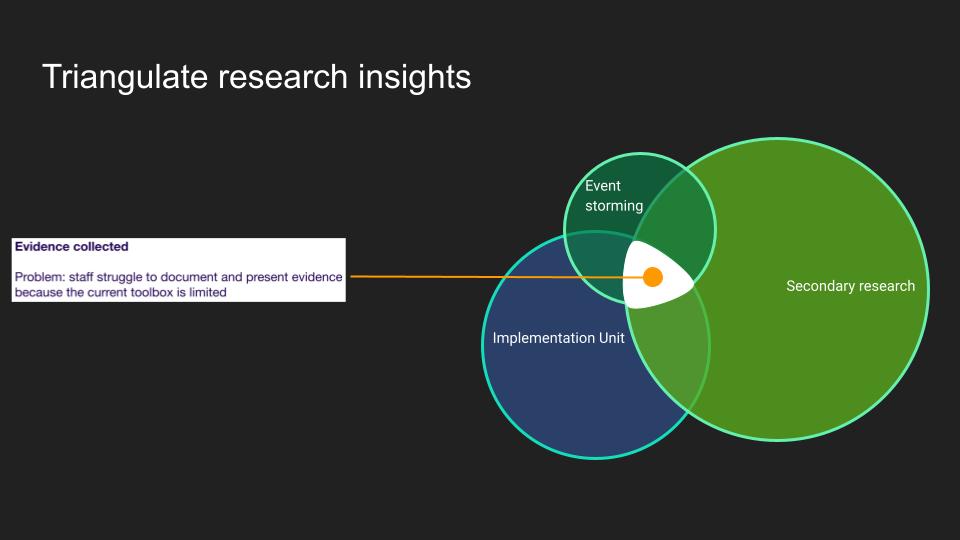
- Triangulated evidence across three sources: event storming, secondary research, and the Implementation Unit's prior work. If only one source showed it, it was a hypothesis. If all three showed it, it was a finding.
- Quantified the cost — breaking down every minute of the 3.9-hour adjudication process to arrive at £55 per case and £13M per year. Made the business case for change concrete.
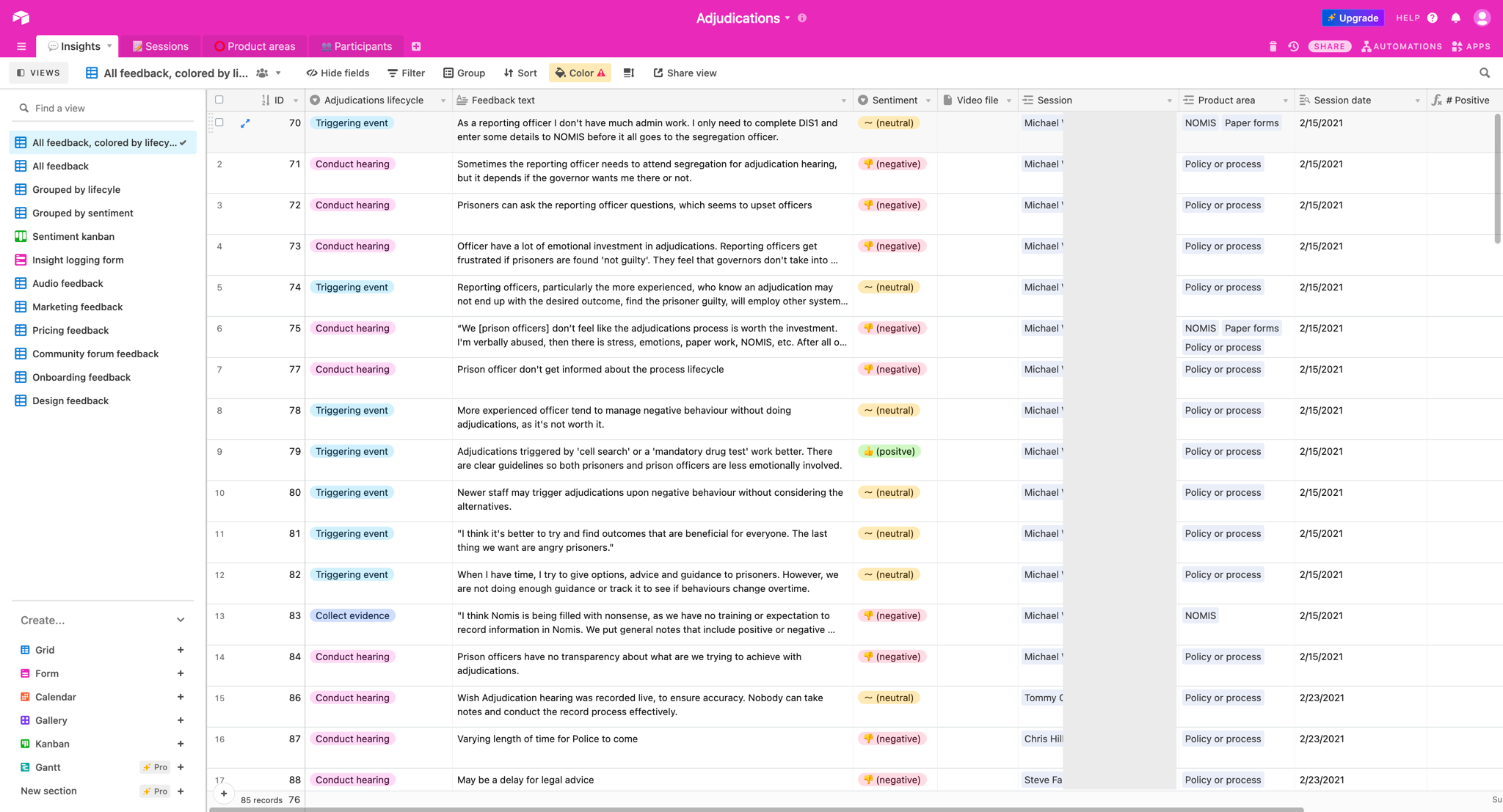
- Built an insight repository in Airtable — tagging every piece of evidence to the adjudication lifecycle stage, user role, and sentiment. Not for storage. For decision-making.
- Helped the team prepare and pass the GDS Discovery Assessment, securing £100K for the Alpha phase.
The hard part
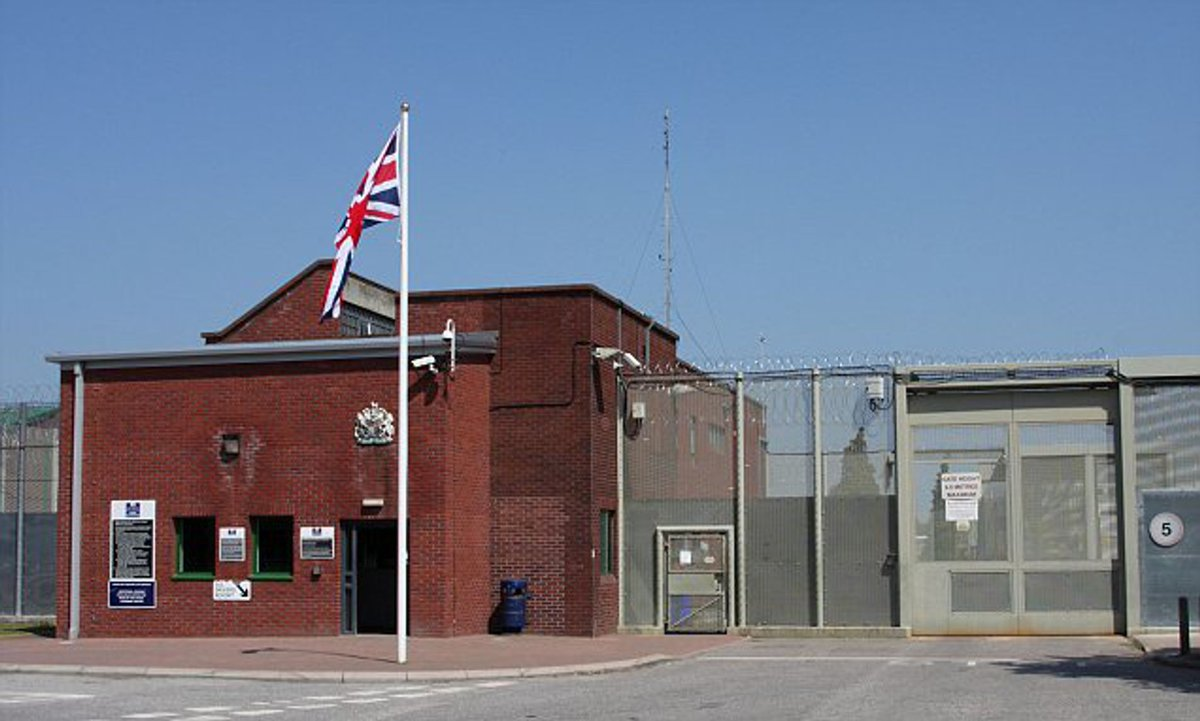
Doing user research inside the prison system is genuinely difficult. Some prison staff you can reach by phone. Others, the ones whose work you most need to understand, you have to visit in person. The tools they use, their workarounds, the way information moves across a shift: you cannot get that on a call.
Speaking with prisoners themselves requires being physically present, navigating access restrictions, and working around schedules set by the institution. Remote research was not an option for the most important parts of this study.
What the research found
Four major problem areas: logistics of hearings (delays, scheduling, attendance gaps), paper vs digital (duplication, human error), clarity of process (training gaps, inconsistency across prisons), and data access. Staff were not failing. The system was.
Outcome
Passed the GDS Discovery Assessment. £100K secured to move into Alpha: building and testing a new digital adjudications service for all 117 prisons in England and Wales.
Reflection
Discovery research is only useful if it is allowed to change things. The hardest skill is not the research itself. It is knowing when the evidence is strong enough to push back on a decision that has already been made. That is a judgment call. In this case, the data was clear enough to be worth the conversation.